-1.png?width=1200&height=312&name=Unilink%20-%20full%20colour%20with%20strapline%20(1)-1.png "Unilink")
Norway's Agder Prison Invests in Self-Service Technology
The Challenge
In 2016, planning began by the Directorate of Norwegian Correctional Service for the new Agder prison.
The southern Norway region had limited prison capacity, and the Directorate was looking to both increase capacity and introduce forward-looking digital solutions.
These solutions were to help streamline work processes and tasks for employees, inmates, partners and the outside world.
The solutions would need to strengthen communication rather than remove the value of direct human contact between employees and inmates.
The principle of normality in the Correctional Service is a progressive approach, stating that:
- The punishment is the restriction of liberty; no other rights have been removed by the sentencing court. Therefore, the offender sentenced has the same rights as all others living in Norway.
- No one shall serve their sentence under stricter circumstances than necessary for the security of the community. Therefore, offenders shall be placed in the lowest possible security regime.
- During the serving of a sentence, life inside will resemble life outside as much as possible.
Agder prison is Norway’s largest, with 100 places in the 65-acre department in Mandal, which opened in June 2020, and a further 200 places in the 95-acre section of Froland, which opened in October 2020.
"When we are building a new prison, we focus on digitalisation. In Agder prison, we have a solid infrastructure with Ethernet, Wi-Fi, RFID, Bluetooth sensors, and electronic door locks. We already had IT systems for employees through secure desktops, but we quickly found out that we don’t have anything for the inmates."
Petter Dalen | Project Manager of the Directorate, Norwegian Correctional Services
The Solution
The new prison gave the Directorate the opportunity to invest in a digital solution which enables offenders, through their own initiatives, to change their criminal behaviour and reduce reoffending. Tryggve Fosse, Director of the Correctional Service in the southwest region, said: “Self-service is an important principle when getting the best possible rehabilitation.”
Unilink Prisoner Self-Service
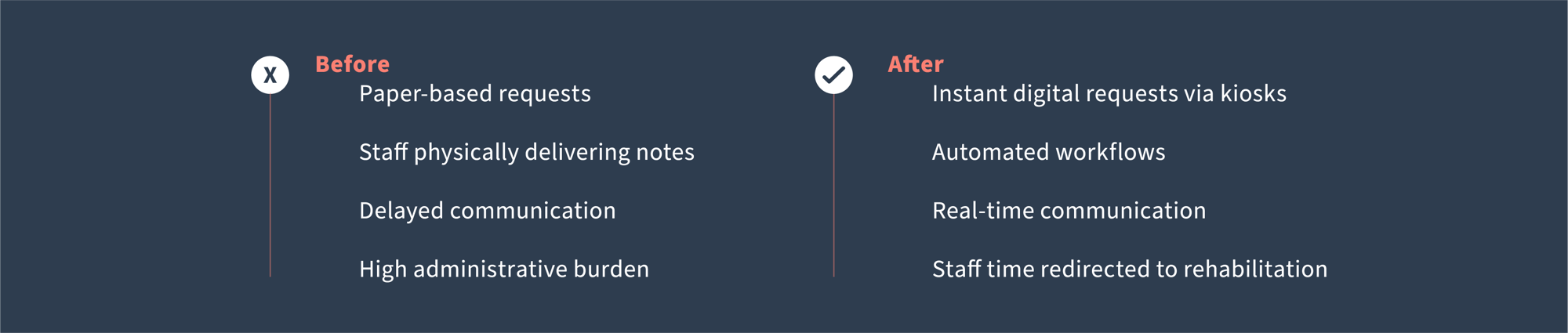
Used by over 55,000 prisoners across more than 70 Establishments in Europe, the UK and Australia, the system has processed over 3 billion transactions to date. Prisoner Self-Service automates many labour-intensive and time-consuming administrative processes, such as ad hoc requests, purchasing items, scheduling visits, and more. This reduces the administrative burden on prison staff whilst giving offenders responsibility for controlling their own affairs, increasing accountability, which has been shown to have a rehabilitative impact. Staff can utilise the time saved by working directly with offenders to foster better relationships.
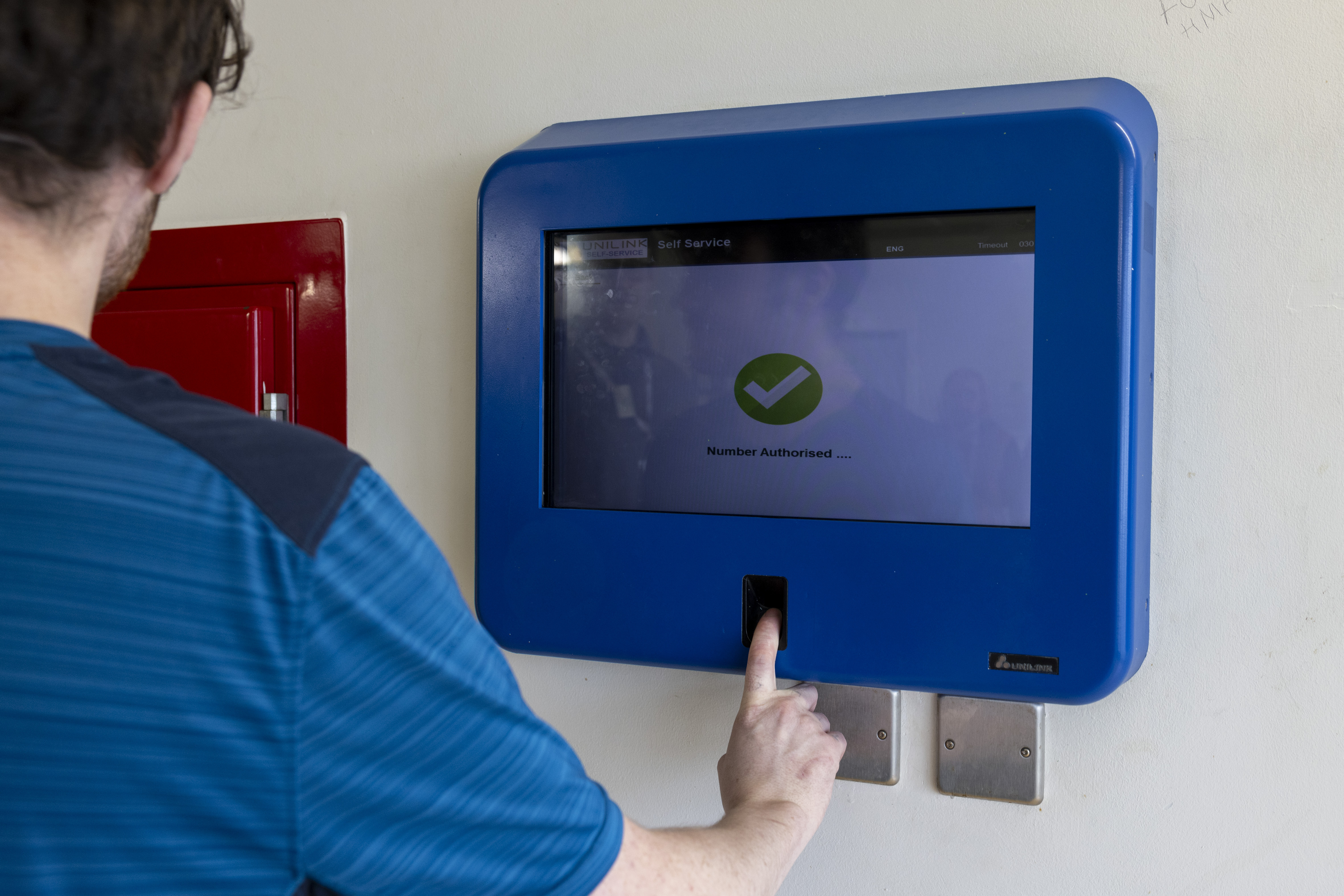
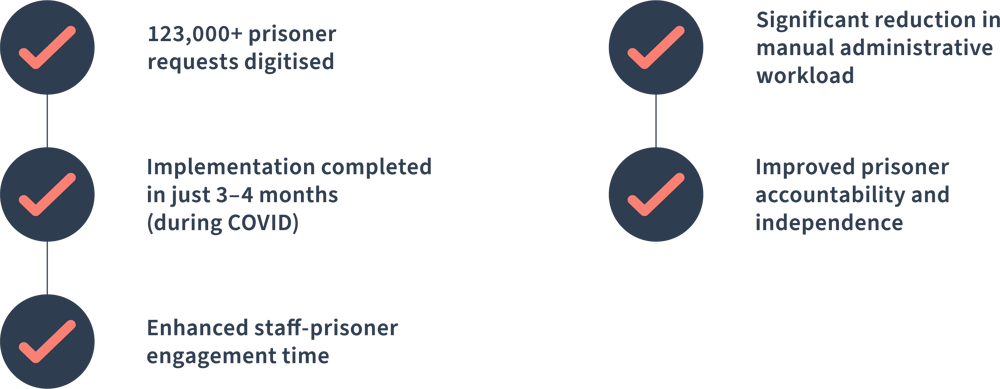
At Agder, Unilink’s wall-mounted kiosks give access to receive messages from employees and relatives and send requests for various reasons, such as booking health appointments. Since Mandal opened in June 2020 and Froland in October 2020 over 123,000 requests have been processed. Petter Dalen, Project Manager, said: “Those are requests that earlier would be written down on notes, handed to a prison officer who had to walk down to the department to deliver the note and then get the message back, so this is a big benefit”.
"First and foremost, the solution will give prisoners a better overview and control over their daily lives. In addition, they receive good digital learning. With several digital solutions available in the criminal justice system, we help create inmates who will do better in the digital community when released. By allowing inmates to manage most of their daily lives, the time spent on administrative tasks is reduced."
Frank Tveiten Johansen | Prison Leader
Key outcomes:
Implementation Process
We had a very fast implementation. We started in March 2020 when the agreement was signed. Mandal opened on 1st June, so we didn’t have more than 3-4 months. During that time, we managed to get the server infrastructure right. Biometrics aren’t allowed in Norway, so Unilink implemented a smart card reader on the kiosks. The smart cards are used by prisoners for logging into kiosks, opening doors, opening drawers, as an ID, and they can pay with it in the shop. We definitely had a good working relationship with the Unilink team from the start. We had a few change requests, which were handled perfectly. We had a very ambitious plan to start off with, and although we didn’t quite follow the project plan to the point, we got the solution out, we got the wall-mounted kiosks up, and inmates could use it from day 1 in Mandal. We planned a good training for our super users in Agder, Simone and Mike (from the Unilink training team) hosted Zoom education and back-and-forth questioning with the super users. The key factor was the mix of personalities and the fact that both teams wanted to succeed."
Petter Dalen | Project Manager
CEO of Unilink, Francis Toye said, “Despite the challenges presented by Covid-19, the lockdown and the prevention of travel to Norway since February 2020, we have managed to implement Prisoner Self-Service in a new prison, for a new customer in a new country and on time. This is a fantastic achievement and testament to the joint project working between the Kriminalomsorgen and Unilink.”
"This is a huge step forward and a boost for the correctional services. Initially, Norway has the world’s best correctional services, but Agder prison facilitates criminal work in a whole new way." - Monica Mæland | Minister of Justice, Norway
Impact Since Installation
Minister of Justice, Monica Mæland, opened the new Agder prison in June 2020 and said “The fact that the inmates can both shop for the food and make it themselves. That they can dispose of their own money and take education is very important. Such a modern prison building provides better conditions for both inmates and employees. It facilitates good content in the sentence. These solutions will provide more effective control of inmates and visitors. They are essential for the return of prisoners to society.”
Petter Dalen, Project Manager, said, “I’m quite impressed that we managed to implement ready for use with all the infrastructure and the things we had to do to set it up due to a pandemic, which also started in March 2020. The use of the system since opening is a testament to how well it has been adopted, and inmates’ feedback to us that the system is easy to use and gives confidence that messages and requests are received every time.”
The Future
"Prisoner Self-Service is what we see in the future across all Norwegian prisons. We still have functionality which we want to release to better the service for offenders and staff. It also has to be part of the inmates’ digital future in Norway. We can educate them, we can give them a lot of benefits whilst inside, but if they don’t follow the digital world outside, if they can’t upload their CV or apply for a job digitally, it’s difficult to succeed in the outside world. These need to be present in prisons if we are to achieve our goals of producing ‘better neighbours’ who don’t come back to prison."
Petter Dalen | Project Manager
"With several digital solutions available in the criminal justice system, we help create inmates who will do better in the digital community when released."
Frank Tveiten Johansen | Prison Leader
Why Unilink?
• Trusted by 55,000+ prisoners across 70+ sites
• 3+ billion transactions processed
• Proven in multiple jurisdictions (UK, Europe, Australia)
• Rapid deployment capability (even during COVID)
Looking to modernise prison operations and improve rehabilitation outcomes?
Talk to Unilink about deploying Self-Service in your estate.
Let’s Build Better Justice
Partner with Unilink to shape the future of secure, fair, and effective justice systems.
Whether you are looking to explore our solutions, request a demonstration, or access our full library of case studies, we are here to help.
For more information about our Self-Service Technology or how we can support your organisation, please contact us.