-1.png?width=1200&height=312&name=Unilink%20-%20full%20colour%20with%20strapline%20(1)-1.png "Unilink")
.jpg?width=1200&height=878&name=Med.lockers%20(2).jpg)
HMP Dovegate
Biometric-enabled lockers providing secure medicine access at HMP Dovegate
The Challenge
HMP Dovegate opened in 2001 on the Staffordshire / Derbyshire border in England. The prison is one of five privately operated by Serco.
HMP Dovegate is a Category B prison, holding up to 860 remand and convicted adult male offenders, as well as up to 200 in a purpose-built Therapeutic Community facility for men serving long or indeterminate sentences.
Across England and Wales, the prison population is ageing, and up to 90% of offenders over 50 have at least one moderate or severe health condition. In 2023, HMPPS data showed that 78% of prisoners in England and Wales received regular prescribed medication.
The site is designated to operate as a resettlement prison, serving the catchment area of Staffordshire and the West Midlands. In a 2019 inspection, 70% of the prison population were serving sentences of 10 years or more.
Offenders often experience problems getting the medication they require. These include flashpoints around medical hatches, offenders being bullied to hand over their medication and offenders having to choose between recreational activities or picking up their medication. These poor offender experiences when collecting medicine cause unsafe environments not just for offenders but for all involved, including prison officers and healthcare professionals.
At HMP Dovegate, healthcare professionals on-site manually dispensed medication to offenders, a time-consuming process that led to many offenders queuing in confined spaces. This restricted the times they could collect their medications, leading to frustration and the potential for illicit exchanges. Covid-19 presented new challenges in the delivery of medications within prisons, and a digitally enabled solution was required.
"In prisons, the administration of regular medication is challenging for the people in our care as well as clinical and custodial staff. In recent years, the use of medication in custodial settings has increased. There have been several factors behind this, including increases in prisoner numbers, an ageing prisoner population, and the prevalence of poor health and long-term conditions amongst prisoners. This has taken place against a background of national increases in medication usage and changes in the classification of tradable medication. Consequently, scoping of a safer, more efficient technological solution was the most logical approach to improving care"
Hayley Peek | Senior Health and Social Care Business Partner Serco
The Solution
HMP Dovegate received a digital solution that streamlines medicine dispensing, ensuring control, accountability, and a complete audit trail. It was developed in collaboration with Serco, who operate HMP Dovegate; Traka, who provided Medication Distribution Lockers; Unilink, who designed and developed the software and Prisoner Self-Service Kiosk hardware; and Practice Plus Group (formerly Care UK), the healthcare partners.
Custodial Management System (Staff Platform)
Providing safety, security and efficiency, Unilink’s Custodial Management System (Staff Platform) integrates biometric fingerprint identification and verification across a wide range of functions: offender, staff and visitor enrolment; movement tracking; access control; Prisoner Self-Service; and integration with Medication Distribution Lockers.
Using biometrics:
Medication Distribution Lockers (MDLs)
Innovative lockers with biometric access linked to the Custodial Management System (Staff Platform). These lockers allow healthcare professionals to load ‘in possession’ medicines specific to each offender into locker compartments that can then be accessed at a
convenient time by the offenders with their fingerprints. This removes the need to see a nurse or doctor, making social distancing easier and reducing the need for close personal contact.
MDLs have a number of benefits for offenders, prison staff and healthcare professionals.
.png?width=2000&height=499&name=dovegate%202@3x%20(1).png "dovegate 2@3x (1)")
For Prison Staff
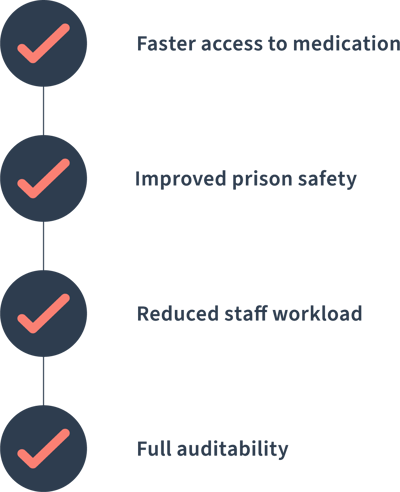
The lockers enable more time and flexibility in planning the daily regime and enable close monitoring of potential “at-risk” offenders.
The system can immediately highlight offenders who have not collected their medication, and has security built in - compartments are allocated randomly every time to prevent storing contraband, and offender fingerprint access once the medication has been collected is removed to prevent “stashing”.
Key outcomes:
"Covid-19 has presented new challenges around the delivery of medications within prisons and there will be a need to consider new ways of delivering essential medication services to prisoners. This Medication Distribution Locker concept will undoubtedly play a role and be one of the many innovations that will support our prisons. It is very encouraging that 80% of respondents found the lockers easy to use."
Hayley Peek | Senior Health and Social Care Business Partner Serco
Best-in-Class Biometrics
Unilink is a world leader in the use of biometrics in the criminal justice sector. Unilink uses IDEMIA’s innovative biometric devices, which are equipped with robust, high-quality optical sensors that capture and process fingerprints with excellent image quality at speeds of quicker than a second. At HMP Dovegate, several types of IDEMIA biometric devices are used throughout the establishment, including Sigma Lite+ devices, which are used with the Medication Distribution Lockers. These devices have duress and fake finger detection, adding an extra layer of security.
After the successful trial, PPG has expanded to 20+ prisons, and several other prison Healthcare providers are also adopting this innovative technology.
Medication Distribution Lockers are available in more than 30 prisons in the UK today.
"Unilink is very pleased to be working in a partnership with Serco, Traka, IDEMIA and Care UK to deliver innovative new ways of working"
Francis Toye | CEO of Unilink
Let’s Build Better Justice
Partner with Unilink to shape the future of secure, fair, and effective justice systems.
Whether you are looking to explore our solutions, request a demonstration, or access our full library of case studies, we are here to help.
For more information about our Medication Distribution Lockers, or to learn more about how we can support your organisation, please contact us.