-1.png?width=1200&height=312&name=Unilink%20-%20full%20colour%20with%20strapline%20(1)-1.png "Unilink")

Digital Transformation in Corrections: A New Model for Safer, More Effective Justice Systems
Executive Summary
Digital infrastructure is no longer optional in modern corrections - it is the most powerful lever available to reduce reoffending, improve safety, and create more humane prison environments.
This paper argues that digital transformation is not simply an operational upgrade, but a systemic shift. By embedding technology into the fabric of prison life,governments can align with the principle of normality, empower individuals in custody, and deliver measurable improvements in safety, rehabilitation, and cost efficiency.
Across the globe, justice systems are under increasing pressure: rising prison populations, escalating costs, staff shortages, and persistent reoffending rates.
Drawing on independent academic research and real-world implementation, this paper introduces a new model for digital corrections. It outlines how governments can transition from legacy systems to future-ready custodial environments.
The System Under Strain
Justice systems worldwide face a structural challenge: balancing public safety, fiscal responsibility, and the humane treatment of individuals in custody.
In the UK alone, reoffending costs society over £20 billion annually. Short sentences remain particularly ineffective, with 68% of individuals released after sentences of six months or less reoffending.
At the same time, prison environments are grappling with complex and interrelated issues:
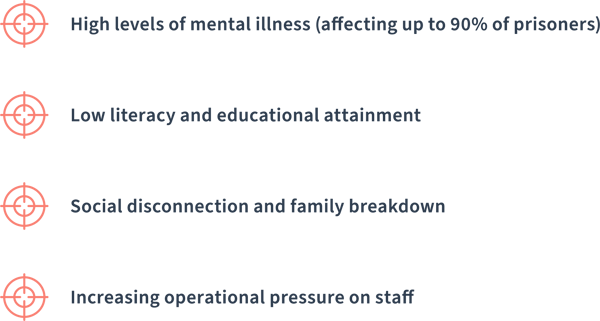
Despite these realities, many prison systems remain rooted in a pre-digital era, lacking even basic infrastructure such as reliable connectivity. This disconnect between life inside and outside prison reinforces exclusion and undermines rehabilitation.
The Hidden Barrier
Digital Exclusion
Modern life is digital. Access to services, employment, education, and social connection increasingly depends on digital capability. Yet prisoners remain among the most digitally excluded populations in society.
This exclusion is not a marginal issue - it is a structural barrier to reintegration. The principle of normality, endorsed by the UN and EU, states that life in custody should resemble life outside as closely as possible. In a digital society, this must now include controlled access to digital tools and services.
Without this, individuals leave custody unprepared for the realities of modern life, increasing the likelihood of reoffending.
"It is absolutely our desire in the Scottish Government to ensure that virtual visits can continue after the pandemic because of the success of their roll-out and the impact that they have had." - Humza Yousaf MSP | Cabinet Secretary for Justice
A New Paradigm
The Digital Rehabilitation Framework
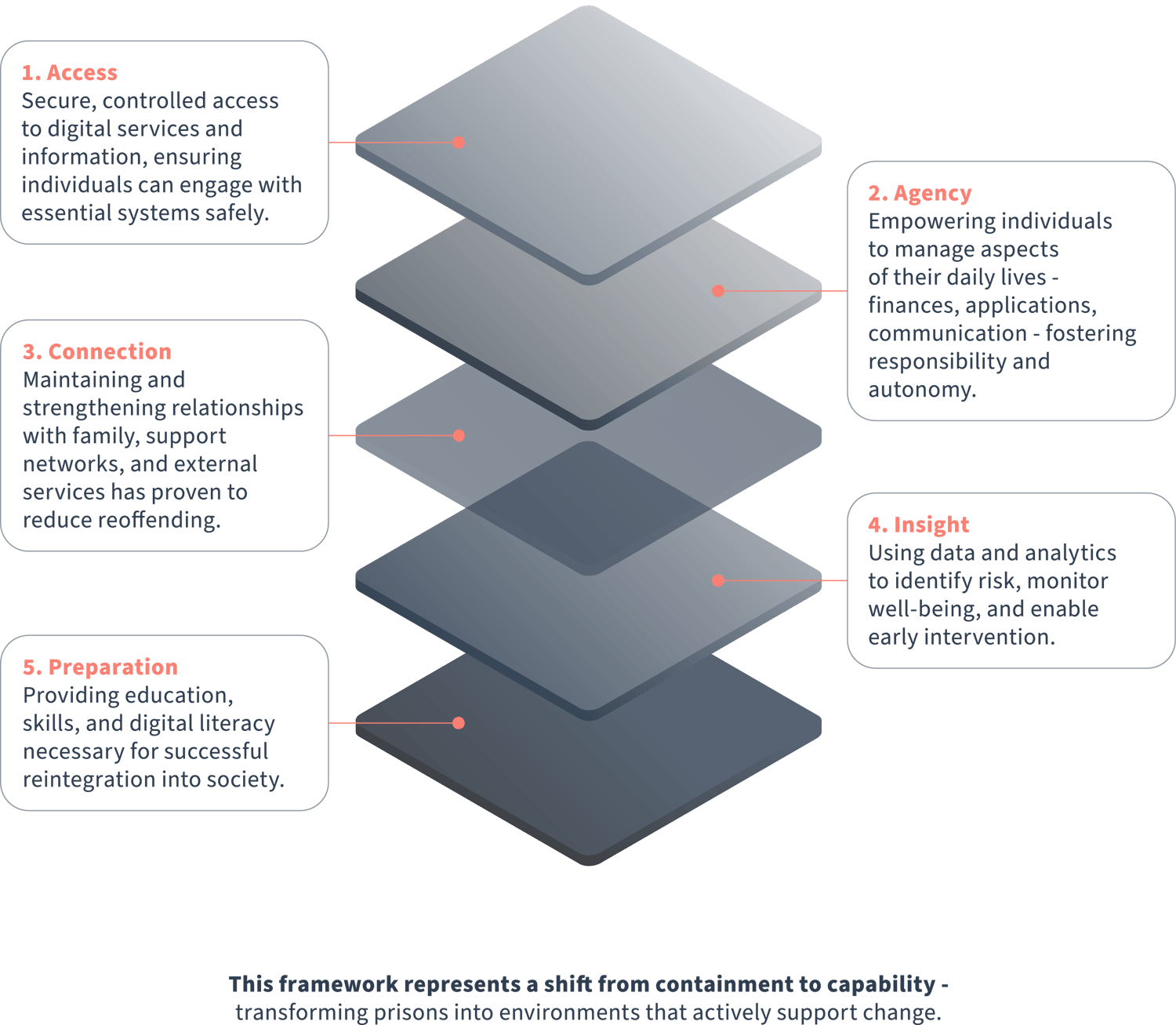
To address these challenges, a new approach is required - one that places digital infrastructure at the heart of correctional strategy.
We define this as the Digital Rehabilitation Framework, built on five core pillars:
"Seeing our brother after months of not being able to visit him in person was really great. It’s really important for both our family and my brother to continue to have positive contact during this extremely difficult time when we have no idea when we may be able to see him in person. Thank you so much for making this possible." - Video Session Customer
From Administration to Transformation
Digital platforms enable a fundamental redesign of prison operations.
Routine administrative processes such as applications, requests, account management and scheduling can be digitised and automated. This does more than improve efficiency; it changes the role of prison staff.
Staff are no longer required to act as administrative intermediaries. Instead, they can focus on meaningful engagement, supervision, and rehabilitation. At the same time, individuals in custody gain control over aspects of their daily lives, restoring a sense of independence and dignity. This dual impact-operational efficiency and human empowerment is central to successful reform.
Evidence of Impact
Independent academic research provides compelling evidence of the benefits of digital transformation in custodial environments.
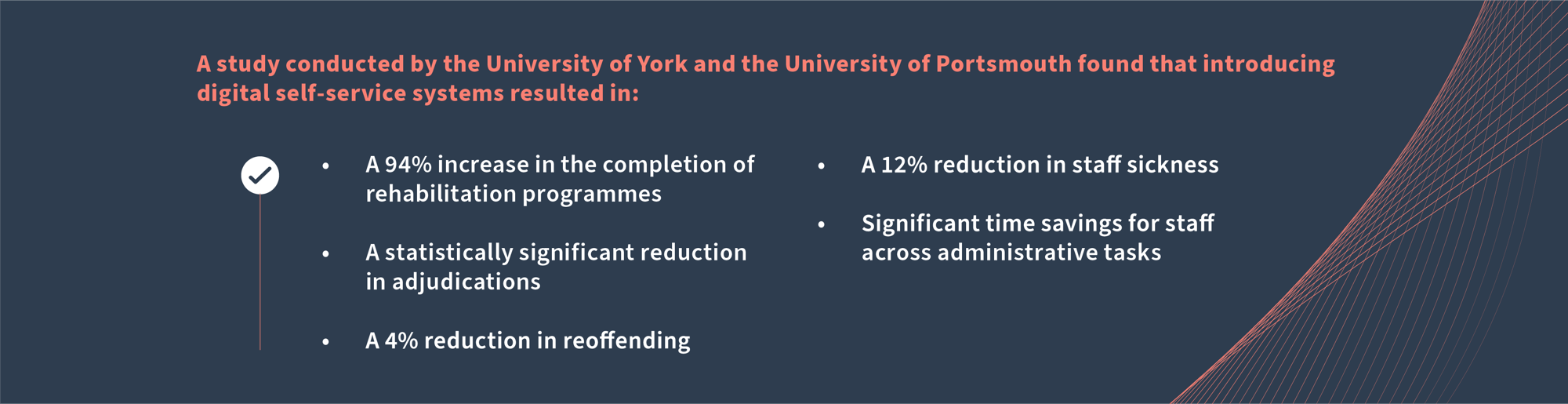
Further evaluation by the University of Leicester confirmed widespread adoption and user satisfaction, with over 90% of prisoners using digital systems regularly.
Crucially, these systems improved transparency, reduced frustration, and enhanced perceptions of fairness - key factors in maintaining order and wellbeing.
Even modest reductions in reoffending translate into substantial societal and economic benefits. At scale, these improvements represent billions in potential savings and, more importantly, thousands of lives redirected.
Advancing Safety Through Data-Driven Insight
Beyond operational efficiency, digital systems enable a new level of insight into prisoner wellbeing and risk.
Advanced tools can integrate behavioural, transactional, and self-reported data to identify individuals at risk of self-harm or suicide.
Independent evaluation has shown that such approaches can deliver:

These outcomes demonstrate the potential of data-driven interventions to save lives, support staff decision-making, and create safer custodial environments.
The Economic Case for Digital Transformation
Digital transformation is not only a social imperative - it is an economic one.
Reducing administrative workload frees up staff capacity, allowing resources to be redeployed where they have the greatest impact. Improved rehabilitation outcomes reduce reoffending, easing long-term pressure on the justice system.
When viewed through a whole-system lens, investment in digital infrastructure delivers disproportionately high returns. Even small percentage improvements in outcomes generate significant financial savings.
A Vision for 2030
The Connected Prison Ecosystem
Looking ahead, the future of corrections lies in fully integrated digital ecosystems.
By 2030, leading systems will:
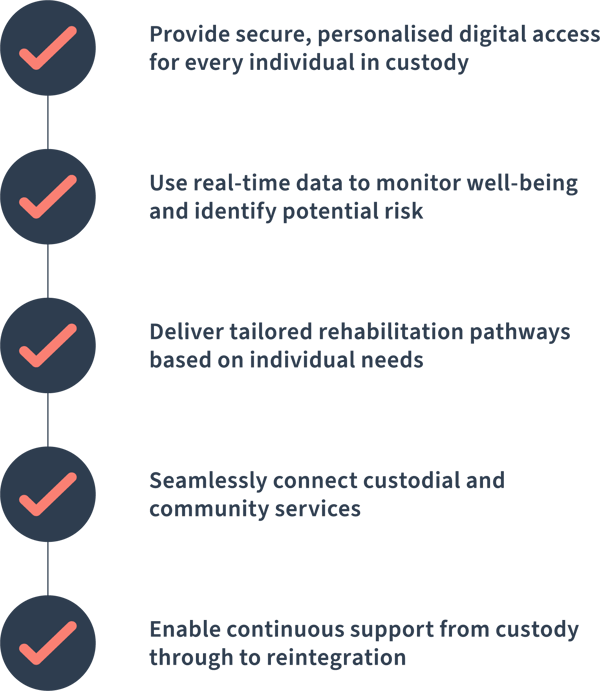
In this model, technology is not an add-on, it is the foundation of a safer, more effective justice system.
Conclusion: From Pilot to Policy
The evidence is clear. Digital transformation improves safety, reduces reoffending, enhances staff effectiveness, and supports more humane custodial environments.
The challenge now is not whether to adopt these approaches, but how quickly they can be scaled. Governments must move beyond isolated pilots and commit to system-wide transformation. This requires investment, leadership, and a clear strategic vision.
Those who act decisively will not only reduce costs, but fundamentally reshape their justice systems for the better - creating environments that protect the public while enabling individuals to change.
Digital infrastructure is no longer optional. It is the foundation of modern corrections.
.png?width=2000&height=514&name=6%20(1).png "6 (1)")
References
McDougall, C., & Pearson, D. (2017)
Evaluation of Prisoner Self-Service Technology in Custodial Environments.
University of York & University of Portsmouth
Palmer, E. (2020)
Evaluation of Digital Technology in Prisons in England and Wales.
University of Leicester (commissioned by the Ministry of Justice)
McDermott, D. (2025)
The Use of Technology in Detecting Risk of Self-Harm & Suicide in Prison: An Independent Evaluation of AIM
Let’s Build Better Justice
Partner with Unilink to shape the future of secure, fair, and effective justice systems.
Whether you are looking to explore our solutions, request a demonstration, or access our full library of case studies, we are here to help.
For more information about Digital Transformation, or to learn more about how we can support your organisation, please contact us.