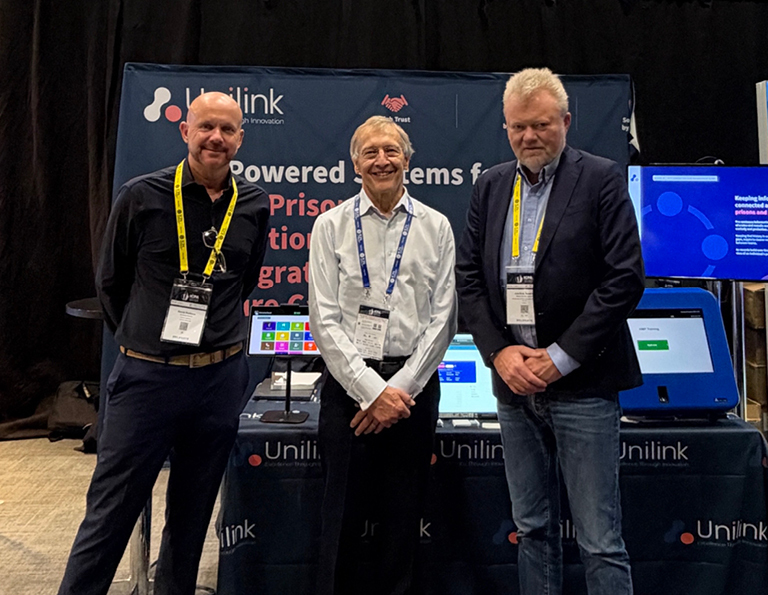
Connected services, responsible AI and meaningful partnerships were the key focuses of Unilink’s conversations at the International Corrections and Prisons Association’s 2026 Annual Conference in Belfast.
From biometric devices and drone detection, to equipment that screens mail for concealed drugs, the exhibition reflected the extraordinary range of technology involved in running a modern prison service.
Yet, for all the innovation on show, the conversation kept coming back to people: the staff working under pressure, those in their care, the families staying connected throughout a sentence, and the practitioners, researchers and community organisations working to make rehabilitation possible.
Across the week, the defining message for the Unilink team was that technology earns its place through the difference it makes to people’s everyday lives.
As a Major Sponsor, we joined the international corrections community in Belfast from 25–30 October for ICPA’s 28th Annual Conference, contributing to discussions around its theme: Partnerships in a Modern Corrections Landscape: Responding to Increasing Growth and Complexity.
What Belfast taught us about change
The Northern Ireland Prison Service’s presentation, From Conflict to Conference, explored its complex journey, while the programme also examined reform, innovation and rehabilitation across the prison service and Youth Justice Agency.
Hearing about the dangers faced by prison officers during the Troubles, the peace process and the service’s subsequent transformation was thought-provoking for our team, bringing home how closely institutional change is tied to the experiences of the people delivering it.
There is also a clear lesson here for technology organisations: understanding a service means understanding its history, culture and working relationships, alongside its operational requirements. Introducing a system is one part of a much longer process of building confidence and changing practice.
Being in Belfast also gave us valuable time with our customers in the Northern Ireland Prison Service, and our conversations reinforced the importance of staying close to the people using our technology as their service continues to evolve.
Partnership needs a place in everyday decisions
One of the most valuable contributions to our stand came from Hanne Kari Kærgaard Kvam, a probation officer from the Norwegian Correctional Service, Kriminalomsorgen, who is embedded in the U-Case.AI project and joined us for two days.
Her presence brought a practitioner’s perspective directly into discussions about digital transformation, helping to highlight how the usefulness of a case management platform depends on how well it reflects real work: the information a practitioner needs, the decisions they must make and the handovers that connect one stage of a person’s journey to the next.
Our work with Kriminalomsorgen on U-Case.AI is centred on supporting connected offender management across prisons and probation. Our shared ambition is continuity of information throughout the justice journey, helping staff work from a shared understanding of the person and their history.
Hanne Kari’s involvement illustrates what meaningful partnership requires; practitioners need an active role throughout development and implementation, with opportunities to question assumptions and influence how the system works.
Reflecting on our conversations, a useful question for any digital transformation programme is: whose experience is shaping the decisions, and how regularly are they involved?
Responsible AI adoption begins with staff confidence
Sam Taylor and Dave Purkess explored another dimension of change in Unilink’s session, AI in Criminal Justice: From Adoption to Operational Opportunity.
Drawing on our own adoption journey, the session connected organisational readiness with practical applications in justice. It covered staff confidence, AI literacy, governance and security, alongside opportunities such as transcription, multilingual support, summaries, form completion, and natural-language reporting.
The wider programme also examined human-centred approaches to implementing AI in correctional operations, placing the people using these tools firmly within the discussion.
Our view is that successful adoption starts with a clearly understood task. Staff need to know what a tool can help them do, where its limitations lie and how to check its output. Responsibility for professional decisions must remain clear.
As such, staff involvement is a key practical requirement; their experience helps identify where AI could remove repetitive work, where it could introduce new difficulties and what support would make it useful.
For leaders, the opportunity is to create the conditions for confident, accountable use, and to measure whether it improves the work.
Connected justice must include families and communities
The conference’s emphasis on people went well beyond prison and probation staff.
Professor Rachel Condry’s presentation examined the importance of families and relationships in punishment and reintegration. Professor Shadd Maruna’s keynote considered reintegration as a shared endeavour involving the individual, the community and the state.
Each perspective has direct implications for technology design. For example, a service may be technically available yet difficult for someone to use. Information may exist within an organisation yet fail to reach the practitioner who needs it, and a digital process may save administrative time while creating barriers for people with limited confidence or access.
For Unilink, keeping people at the centre means asking how services work from their perspective. Can someone maintain contact with their family? Can they manage a routine request with greater independence? Can staff access relevant information without repeatedly searching or re-entering it?
Those everyday experiences should help define what progress looks like.
Taking the conversations forward
Alongside demonstrations and sessions, we had meaningful conversations with representatives from around the world. Different jurisdictions brought different experiences, giving us much to reflect on and follow up.
Our hosted dinner offered another opportunity to continue those exchanges, spend time with customers and partners, and build relationships beyond the conference programme.
We are grateful to everyone who visited our stand, joined our session or shared their perspective with us, and to ICPA and the Northern Ireland Prison Service for bringing the international community together.
We returned from Belfast with new ideas and a renewed sense of responsibility for how we apply them. The test for innovation in corrections is what happens after the demonstration: whether staff can work more effectively, people can access the support they need and services can maintain continuity across organisational boundaries.
That is the work we look forward to continuing with our partners.
If we spoke in Belfast, or missed the opportunity, we would welcome a conversation about the challenges your service is working to address. Get in touch with Unilink.